
Garage Door Won't Close? 8 Causes and Fixes
A door that opens fine but won't close is one of the most common calls we get, and the good news is the fix is usually cheap and safe. Nine times out of ten it's the safety sensors near the floor, not a broken part.
Here's why that's the prime suspect: every opener made since the early 1990s has photo-eye sensors that stop the door from closing on a car, a pet, or a kid. When those eyes can't see each other, the opener assumes something is in the way and refuses to close. That safety feature is doing its job, it just needs a nudge.
We'll work through the eight usual causes below, from easiest to hardest. A quick note on our area first. Plenty of Norwalk garages sit on 1950s tract homes with original hardware, and our marine-layer mornings rust cables and cloud sensor lenses faster than you'd think. So some of these failures were building for a while. Anything under spring or cable tension is a pro job, and we'll flag those clearly.
1. Misaligned or Dirty Safety Sensors (Most Common)
Start here. If your opener light blinks when you press the button, or the door starts down and reverses, the photo-eyes are your problem about 80% of the time.
Look at the two small sensors mounted on each track, usually four to six inches off the floor. Each has a tiny LED. On most brands one glows steady (the sending eye) and the other glows steady when it's aimed correctly (the receiving eye). If either is off or blinking, they're out of line or dirty.
- Wipe both lenses. Garage dust and coastal film build up on the glass. A dry cloth or a soft rag usually clears it.
- Check alignment. Loosen the wing nut or bracket screw on the sensor with the bad light. Gently tilt it until the LED glows solid and steady, then retighten.
- Test. Press the wall button. The door should close in one smooth run.
This is a safe DIY fix. For a full step-by-step with photos of both LEDs solid, see our guide on garage door sensors not working.
2. Something Blocking the Beam or the Path
Before you touch anything, look down the door opening. The sensors see a straight invisible line across the floor, and anything crossing it stops the close.
- Obvious blockers: a trash can, a bike tire, a broom, a bag of soil leaning against the track.
- Sneaky ones: a coiled extension cord, a spider web strung between the eyes, a stray leaf blown in on a windy morning.
- The door's own path: a box on a shelf that overhangs the door, or a stored item the bottom panel would hit on the way down.
Clear the opening and try again. This one costs nothing and fixes a surprising number of no-close calls.
3. Loose or Damaged Sensor Wiring
If the lenses are clean and aligned but a sensor LED still won't light, the wiring between the sensor and the opener may be loose, pinched, or corroded.
The thin wires run up the track and across to the opener head. Over years they get stapled tight, nicked by a ladder, or chewed by a rodent. In our damp climate the little connection points also corrode.
- Follow each wire and look for a break, a pinch point, or a staple driven through the insulation.
- Check the terminals on the back of the opener where the sensor wires connect. Make sure they're seated and not green with corrosion.
Reseating a loose wire is fine to do yourself. If a wire is cut or the terminals are corroded, that's a job for our opener repair technicians, who can test the circuit and replace the sensor or harness.
4. Close-Limit and Travel Settings on the Opener
Every opener has adjustment screws or buttons that tell it how far to travel and how much force to use. If the close-limit is set so the door hits the floor with room to spare, the opener thinks it hit an obstruction and reverses back up.
You'll notice this when the sensors are fine, nothing is blocking the path, but the door still touches down and bounces open. On Chamberlain, LiftMaster, Genie, and Craftsman units there are usually two dials or a set-limit routine on the motor head.
- Find the down-limit adjustment (check the label on the opener).
- Turn it in small increments so the door travels slightly farther down.
- Test after each small change until the door seats on the floor and stays closed.
This is DIY-safe, but go in tiny steps. Too much down-force is a safety hazard, so if you can't get it to seat without slamming, have us set it properly.
5. Broken Torsion Spring (Call a Pro)
Here's where DIY stops. If the door slams down fast, or the opener strains and won't hold the door partway, the spring above the door may be broken.
The torsion spring counterbalances the door's weight. When it snaps, the opener is suddenly fighting a very heavy door with no help, and the safety system reverses or the door drops. You may have heard a loud bang, like a firecracker, earlier that day, that's the spring letting go. Springs are rated around 10,000 cycles, roughly 7 to 12 years, so this is the classic failure on older Norwalk doors.
Do not try to close or force the door. A door with a broken spring can drop hard. This needs professional spring repair, and we carry the right springs for your door's weight.
6. Frayed or Loose Lift Cable (Call a Pro)
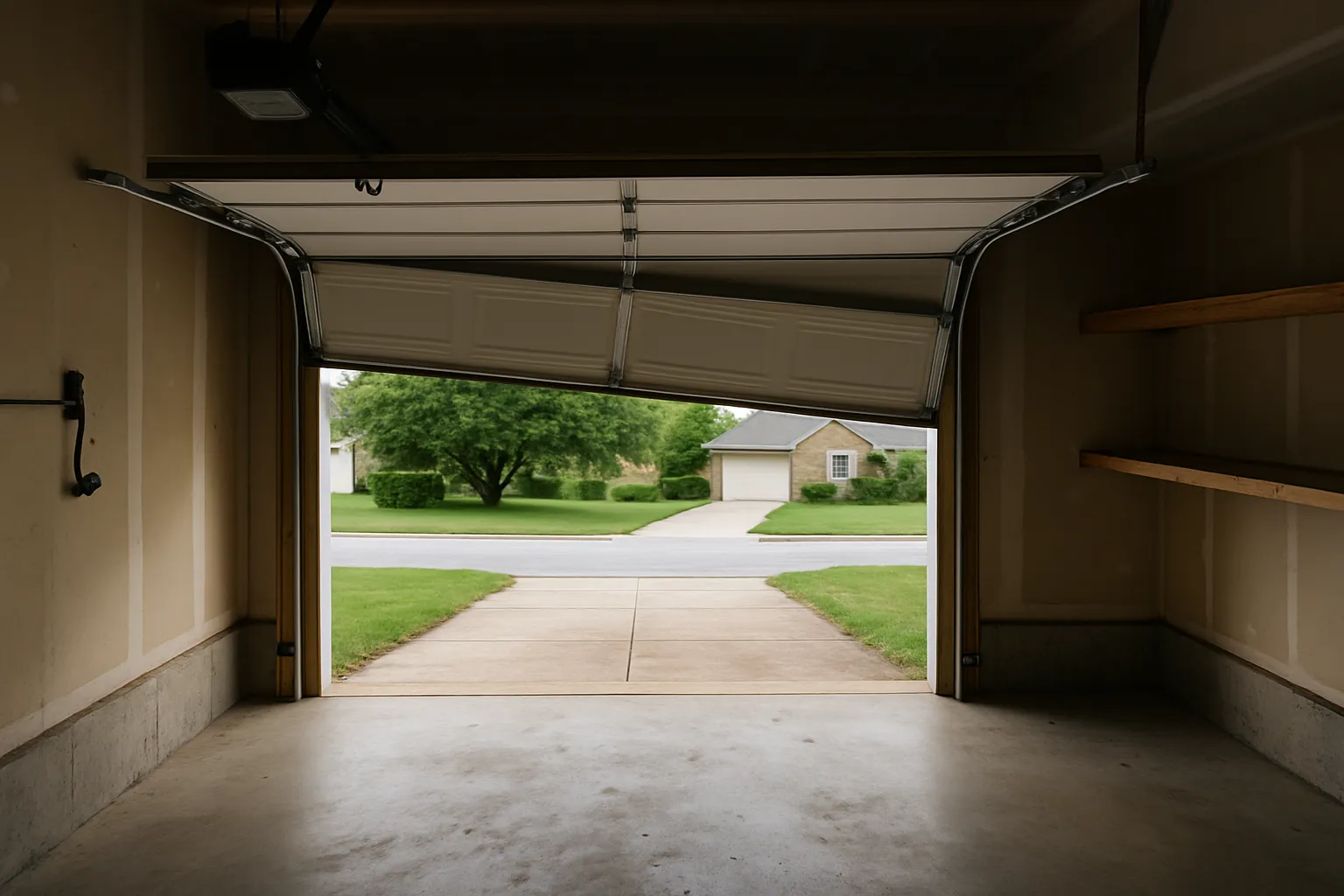
The steel lift cables run alongside the springs and carry the door's weight up and down. When one frays or slips off its drum, the door hangs crooked and won't close square.
Signs to look for:
- One bottom corner sits lower than the other.
- You see a loose or dangling cable on one side.
- Rust and fraying where the cable meets the bottom bracket, common after years of damp Norwalk mornings.
Cables are under the same tension as springs. A frayed cable can snap without warning, so don't operate the door and don't try to reset it by hand. Get cable repair from a technician.
7. Bent Track or a Door Off Its Track (Call a Pro)
If the door binds partway down, looks crooked, or a wheel has jumped the rail, the track is bent or the door is off-track. This often happens after someone bumps the door with a car, or after an earthquake jolts an older door.
Running the opener on an off-track door bends the rails worse and can drop the door. Stop pressing the button. This is a off-track and roller repair job, where we realign the door on the rails and straighten or replace bent track sections safely.
8. Rollers Binding in the Track
Rollers are the small wheels that guide the door along the track. When they rust, lose their bearings, or dry out, they drag and bind, and the door stutters or stalls on the way down.
You can do the light maintenance yourself:
- With the door closed, look at the rollers. Cracked nylon or rusted steel wheels need replacing.
- Wipe the tracks clean of grit, then apply a garage-door lubricant (a lithium or silicone spray) to the rollers and hinges. Skip WD-40, it's a solvent, not a lubricant.
- Run the door and watch for a roller that wobbles or hangs up.
Cleaning and lubricating is DIY-safe. Replacing rollers on the bottom brackets, though, puts you near the cable tension, so leave those bottom rollers to us. A worn set is usually replaced during roller repair.
Get Same-Day Help in Norwalk
Worked through the list and the door still won't close? If it's the sensors, a blockage, or an opener setting, you've likely got it handled. If it's a spring, cable, or off-track door, don't force it, that's how a small fix becomes a big one.
Call (562) 667-4784 for same-day service and 24/7 emergency garage door repair across Norwalk (90650) and southeast LA County, or request service online.
Questions, Answered
Why does my garage door reverse right before it closes?
Two common causes. Most often the photo-eye sensors near the floor are dirty or out of alignment, so the opener thinks something is in the way. Less often, the close-limit or down-force setting is off, so the door hits the floor early and bounces back up. Clean and realign the sensors first, then check the limit settings.
My opener light blinks and the door won't close. What does that mean?
A blinking opener light is the classic signal that the safety sensors are blocked, dirty, or misaligned. Clear anything crossing the door opening, wipe both sensor lenses, and adjust them until both LEDs glow steady. This is a safe DIY fix and solves most no-close problems.
Can I close my garage door if the spring is broken?
No, don't. A broken torsion spring leaves the door's full weight unsupported, and it can drop hard and fast. Leave the door where it is and call a technician. Springs are under high tension and need to be matched to your door's weight, so this is not a DIY repair. Call (562) 667-4784.
The door closes if I hold the wall button down. Why?
Holding the wall button usually overrides the sensor safety reversal, which confirms the photo-eyes are the issue. Don't rely on that as a fix, it bypasses a safety feature. Realign and clean the sensors so the door closes normally on its own.
How much does it cost to fix a door that won't close?
If it's the sensors or a setting, often nothing beyond a service call. If it's a spring, cable, or off-track door, expect roughly $150 to $450 depending on the part. See our Norwalk repair cost guide for a full breakdown. We quote before we start any work.
Do you offer same-day service in Norwalk?
Yes. We run same-day and 24/7 emergency service throughout Norwalk and nearby southeast LA County cities. Call (562) 667-4784 and we'll get a technician out to you.
Need Help in Norwalk?
Garage Door Pro Norwalk provides fast, same-day garage door repair across Norwalk, CA and the surrounding area — flat-rate pricing, licensed and insured, with 24/7 emergency service. Landed on this article from a search? Head back to our homepage to see everything we do, or reach out now.