
Garage Door Sensor Not Working? How to Realign It
If your garage door won't close, reverses on its way down, or the opener light keeps blinking, the safety sensors are almost certainly the reason. It's the single most common garage-door complaint we get, and the fix is usually free and takes about five minutes.
Better still, it's one of the few garage-door repairs that's genuinely safe to do yourself. There's no spring or cable tension involved, just two small eyes near the floor that need to see each other. This guide walks you through realigning them until both lights glow steady, plus the other reasons the sensors act up.
A quick local note. Norwalk's marine-layer mornings leave a film on the sensor lenses and rust the brackets, and many of our 1950s tract homes have sensors mounted years ago that drift out of line over time. So if yours quit today, a wipe and a nudge often brings it right back.
How Photo-Eye Safety Sensors Work
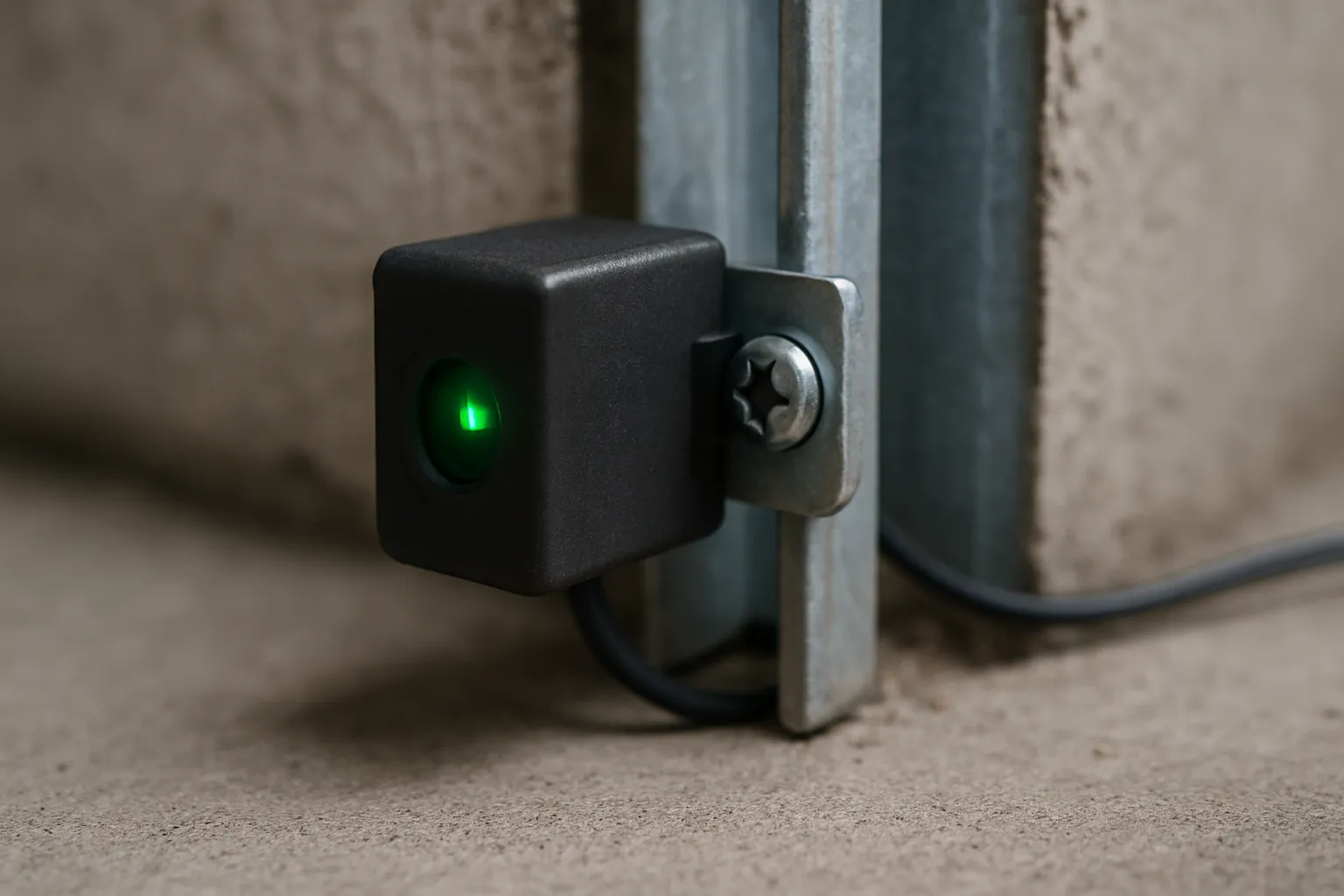
Since 1993, federal safety rules have required every residential opener to have photo-eye sensors. You'll find two small units bolted to the tracks on each side of the door, usually four to six inches off the floor.
One sensor sends an invisible infrared beam across the opening. The other receives it. As long as that beam is unbroken, the opener knows the path is clear and will close the door. The moment something crosses the beam, a car, a pet, a foot, the opener stops and reverses so the door can't close on it.
The catch is that the sensors also refuse to close the door if the beam is broken for the wrong reasons: a dirty lens, a knocked-loose bracket, or a bad wire. The opener can't tell the difference between a real obstruction and a misaligned eye, so it plays it safe and won't close.
Symptoms of a Sensor Problem
These are the tell-tale signs the photo-eyes are the issue rather than a spring or opener fault:
- The door won't close at all, though it opens fine.
- The door starts down, then reverses back up before it reaches the floor.
- The opener light blinks several times when you press the button, that blink is the opener's way of flagging a blocked or misaligned sensor.
- The door only closes if you hold the wall button down, which overrides the safety reversal.
If that matches what you're seeing, work through the steps below. If instead the door is heavy, bangs, or the opener strains, that's a different problem, see our guide on why a garage door won't close for the full list of causes.
Step-by-Step: Realign the Sensors
The goal is to get both sensor LEDs to glow solid and steady at the same time. Here's how:
- Find the LEDs. Each sensor has a small indicator light. On most brands the sending eye stays a steady green, and the receiving eye glows steady (often amber or red) only when it's aimed correctly. If either light is off or flickering, that eye is out of line.
- Loosen the misaligned sensor. Back off the wing nut or bracket screw just enough that you can tilt the sensor by hand.
- Aim it slowly. Gently pivot the sensor left, right, up, and down while watching its LED. When the light snaps on and holds steady, you've found the line of sight.
- Tighten and recheck. Snug the wing nut without shifting the aim. Confirm both LEDs are now solid.
- Test the door. Press the wall button. The door should close in one smooth run with no reversing.
That's it, no tools beyond your fingers on most units. This is completely DIY-safe.
Clean the Lenses and Clear Obstructions
Before you decide the sensors are broken, rule out the two simplest causes.
Dirty lenses. The small glass eye collects dust, cobwebs, and the fine film our coastal air leaves behind. A clouded lens weakens the beam enough to break it. Wipe both lenses with a soft, dry cloth. Skip harsh cleaners, they can haze the plastic.
Obstructions. The beam runs in a straight line across the floor. Look for anything crossing it: a trash can, a bike wheel, a coiled hose, a broom leaning on the track, even a stray leaf or a spider web strung between the two eyes. Clear the opening and try again.
Between cleaning and realigning, you've now solved the large majority of sensor problems.
Loose or Damaged Wiring
If a lens is clean and you've aimed the sensor carefully but the LED still won't light, suspect the wiring. Thin wires run from each sensor up the track and over to the opener head.
- Follow each wire and look for a pinch, a nick, or a staple driven through the insulation. Ladders and stored items nick these often.
- Check where the wires connect to the terminals on the opener. Reseat any that look loose.
- In our damp climate, watch for corrosion, green or white crust, on the terminals or on the sensor's own connections.
Reseating a loose wire is fine to do yourself. But a cut wire, a shorted run, or corroded terminals need testing and replacement. That's a job for our opener repair technicians, who can trace the circuit and swap the faulty sensor or harness.
Sun Glare and Sensor Height
Two less obvious gremlins:
Sun glare. If your garage faces the afternoon sun, direct light hitting the receiving eye can wash out the beam and cause random reversals, usually at the same time each day. A simple fix is a small sun shield, a short section of tube or a cardboard hood, to shade the receiving lens. Swapping which side sends and which receives can also help.
Sensor height. Code and manufacturers call for the sensors to sit no higher than six inches off the floor, so the beam catches a small child or pet. If yours have drifted higher over the years, or were mounted too high, lower them on the bracket. That both meets the safety intent and keeps stored items from blocking the beam.
When to Call a Pro
You've cleaned the lenses, cleared the path, realigned both eyes, and checked the wiring, and the door still won't close. At that point the sensor unit itself may have failed, the opener's logic board may be faulty, or the wiring has a break you can't see. Those need a technician's meter and replacement parts.
Also call us if you find damaged wiring, corroded terminals, or a sensor bracket rusted through, all common on older Norwalk hardware. And if the door's trouble turns out not to be the sensors at all, a heavy door, a bang, an opener straining, stop and have it checked, since that points toward springs or the opener drive.
You can reach us any time at our contact page or by phone.
Same-Day Sensor Help in Norwalk
Most sensor problems you can fix in five minutes with a wipe and a nudge. When it's the wiring, the board, or a dead sensor, we'll get it sorted fast.
Call (562) 667-4784 for same-day service across Norwalk (90650) and southeast LA County, or request service online. We handle every brand, Chamberlain, LiftMaster, Genie, and Craftsman.
Questions, Answered
How do I know if my garage door sensors are misaligned?
Look at the small LED on each sensor near the floor. When they're aligned, both glow solid and steady. If one is off or blinking, that eye is out of line. Loosen its bracket, tilt it slowly until the light holds steady, and retighten. Both lights solid means the beam is connected.
Why does my garage door open but not close?
The photo-eye safety sensors are the usual reason. When the beam between them is broken, by dirt, misalignment, an obstruction, or a bad wire, the opener refuses to close the door as a safety feature. Opening is unaffected. Clean the lenses, clear the path, and realign the sensors so both LEDs glow steady.
Can sunlight affect my garage door sensors?
Yes. Direct sun on the receiving eye can wash out the infrared beam and cause the door to reverse, often at the same time of day. Shade the receiving lens with a small hood or tube, or swap which sensor sends and which receives. That usually stops the sun-related reversals.
How high should garage door sensors be mounted?
No more than six inches off the floor. That height lets the beam catch a small child or pet in the door's path. If yours have drifted higher over the years, lower them on the bracket, it meets the safety intent and keeps stored items from breaking the beam.
Are garage door sensors safe to fix myself?
Yes, the common fixes are. Cleaning the lenses, clearing obstructions, realigning the eyes, and reseating a loose wire involve no spring or cable tension, so they're safe DIY. What needs a pro is a cut wire, corroded terminals, a failed sensor, or a bad opener board. Call (562) 667-4784 for those.
Need Help in Norwalk?
Garage Door Pro Norwalk provides fast, same-day garage door repair across Norwalk, CA and the surrounding area — flat-rate pricing, licensed and insured, with 24/7 emergency service. Landed on this article from a search? Head back to our homepage to see everything we do, or reach out now.